Whatsapp: +447599352109


{{ variable.name }}
When you're considering a ROLEX Daytona with a ceramic case, Super-Luminova markers, and the option between quartz or mechanical movement, the decision isn't straightforward. This review breaks down what you're actually getting with this 43mm chronograph from Shopping Yiwu, comparing it to both genuine Rolex models and other high-end replicas.
The ceramic case is a standout feature. Unlike standard stainless steel or plated brass, the ceramic resists scratches and fading. The bezel is engraved with the tachymeter scale, and the ceramic insert feels dense and cool to the touch. The 43mm diameter suits larger wrists, though the case thickness (around 14mm) is slightly thicker than a genuine Daytona (12.5mm). The bracelet uses solid links with a fold-over clasp and safety latch, but the weight is noticeably lighter than a genuine stainless steel bracelet—expected at this price point.
The key differentiator here is the movement. The quartz version uses a Miyota or similar Japanese movement, offering reliable timekeeping with a sweeping seconds hand (though not perfectly smooth like a mechanical). The mechanical version houses a Seiko or Chinese automatic movement (like the 2813 or 4813). Let's be honest: Neither mimics the Rolex 4130 in-house movement, but for daily wear, the quartz is more accurate and requires less maintenance. The mechanical option provides the 'feel' of an automatic, but the rotor noise is more audible and the power reserve is around 40 hours. If you value precision over tradition, go quartz. If you want the 'automatic experience' on a budget, the mechanical will suffice.
The dial layout mimics the Daytona's three-subdial design with running seconds at 6, 30-minute counter at 3, and 12-hour counter at 9. The Super-Luminova lume on hands and indices is applied generously, glowing bright blue after exposure. However, the lume fades after a few hours—comparable to Seiko's standard lume but not to the prolonged glow of genuine Rolex Chromalight. The date window at 3 (often with a cyclops) is functional but the date font is slightly thinner than gen.
The quartz chronograph uses a central seconds hand that stops/starts with the top pusher, while the subdials track elapsed time. The mechanical chronograph, however, uses a cam-actuated movement (like the 7750 clone) with a seconds hand that stutters—it's not a true column wheel. The pushers feel stiff and require a firm press. Neither movement offers the smooth start-stop of a genuine Rolex, but for timing events, either works adequately.
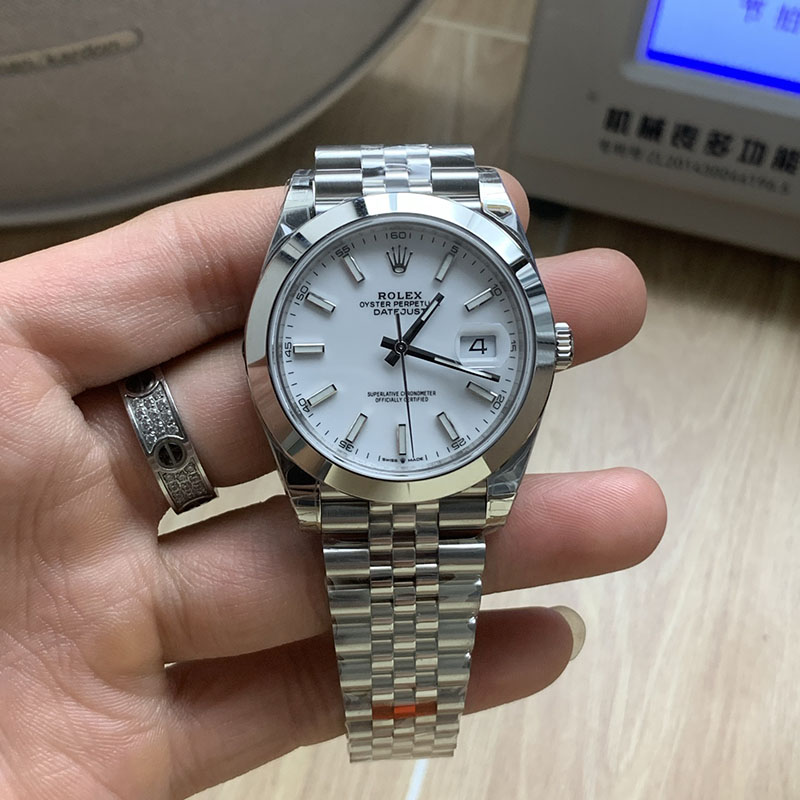
The dial reads 'ROLEX' and 'OYSTER PERPETUAL' with 'DAYTONA' below 12. The crown has the Rolex coronet. The caseback is solid with minimal engravings. The overall look is convincing to the untrained eye, but watch enthusiasts will notice the misaligned subdial hands (common in budget replicas) and the slightly flat crystal. The sapphire crystal has decent AR coating, but reflections are more pronounced than genuine.
A genuine ceramic Daytona retails for over $15,000 and uses an in-house 4130 movement with 72-hour power reserve, column wheel chronograph, and 100m water resistance. This replica costs less than $400 offers no water resistance (do not submerge), a fraction of the power reserve (if mechanical), and a lower grade of finishing. But the visual similarity is striking—from a foot away, most people won't tell the difference. If you're buying for the look without the investment, this is a viable option.
At $389.99 from Shopping Yiwu, this watch is a decent value for the aesthetic. The ceramic case and Super-Luminova are genuine upgrades over cheaper replicas. The quartz movement is the safer choice for reliability, while the mechanical offers a more traditional feel. Don't expect Rolex-level finishing or durability—this is a fashion accessory, not a tool watch. If your goal is to see if a Daytona style suits you, or you need a conversation starter without the price tag, this watch delivers. Just know what you're getting.